
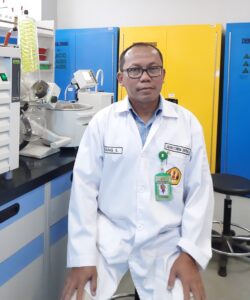
Calon Promotor Program Padjadjaran Excellence Fastrack Scholarship Tahun 2024
Nama Lengkap : Prof. Dr. Unang Supratman
E-mail : [email protected]
Bidang Keahlian : Kimia Organik Bahan Alam
Prodi S2 Calon Mahasiswa: Kimia
Prodi S3 Calon Mahasiswa: Kimia
udul Penelitian yang Ditawarkan:
Senyawa metabolit sekunder dari tumbuhan Dysoxylum Indonesia dan aktivitas sitotoksik terhadap sel kanker payudara MCF-7
Secondary metabolites from Indonesian Dysoxylum plants and their cytotoxic activity ganst MCF-7 breast cancer cellsulum
Abstrak:
Triterpenoid merupakan senyawa metabolit sekunder yang tersusun dari kerangka karbon yang berasal dari enam satuan isoprene (2– metilbuta-1,3-diene) satuan C5 dan diturunkan dari hidrokarbon C30 asiklik, yakni skualena. Senyawa triterpenoid sudah berhasil diisolasi pada genus Dysoxylum pada genus tersebut diketahui memiliki sifat-sifat sitotoksik, Beberapa jenis senyawa yang berhasil diisolasi dari genus ini meliputi seskuiterpen, diterpenoid, triterpenoid, dan limonoid, dan beberapa di antaranya menunjukkan aktivitas yang menarik terhadap sel kanker payudara. Berdasarkan penelitian sebelumnya melaporkan bahwa triterpenoid yang diisolasi dari D. cumingianum menunjukkan kemampuan menghambat P-gp pada sel kanker MCF-7, yang berpotensi menjadi agen dalam pengobatan kemoterapi yang menjanjikan. Upaya pencarian senyawa triterpenoid dari genus Dysoxylum terus dilakukan. Objek penelitian kali ini adalah spesies D. amooroides yang hingga saat ini belum dilakukan eksplorasi senyawa triterpenoid dan aktivitas sitotoksiknya terhadap sel kanker payudara dari D. amooroides khusus nya pada bagian kulit batang. Hal ini dilakukan untuk mendapatkan senyawa triterpenoid dengan aktivitas sitotoksik yang baik sehingga dapat dijadikan sebagai bahan obat antikanker terutama kanker payudara yang merupakan kanker paling mematikan di dunia. Berbagai cara pengobatan kanker payudara seperti kemoterapi dan radioterapi telah dilakukan, namun tingkat kelangsungan hidup pasien masih rendah yaitu 44% dalam 1 tahun dan 17% dalam 5 tahun. Melihat permasalahan tersebut, riset terhadap D. amooroides dapat menjadi solusi pengobatan kanker, dan besar peluang penelitian ini menjadi penelitian baru yang belum pernah dilaporkan sebelumnya. Tujuan dari penelitian ini adalah untuk memperoleh senyawa triterpenoid yang memiliki aktivitas anti kanker terhadap sel kanker payudara dan sel normal serta mempelajjari mekanisme kerjanya sebagai anti kanker payudara. Tahap isolasi dilakukan dimulai dengan maserasi kulit batang D. amooroides dengan pelarut etanol kemudian dilanjutkan dengan partisi menggunakan pelarut n-heksana, etil asetat dan n-butanol sehingga diperoleh ekstrak pekatnya. Selanjutnya tiap ekstrak pekat tersebut diuji sitotoksik terhadap sel kanker payudara. Ekstrak yang aktif kemudian dipisahkan dan dimurnikan dengan berbagai teknik kromatografi. Isolat murni dikarakterisasi dengan berbagai metode spektroskopi meliputi; spektrometri inframerah, spektrometri massa, 1H-NMR, 13C-NMR, dan 2D-NMR, serta diuji aktivitas sitotoksiknya terhadap sel kanker payudara dengan metode presto blue secara uji in vitro. Luaran yang ditargetkan dari penelitian ini : (1) Publikasi di jurnal Molecules Q1, Seminar Nasional atau Internasional serta publikasi seminar ilmiah (tahun ke-1), (2) Publikasi di Jurnal Phytochemistry Letters Q2, Seminar Nasional atau Internasional serta publikasi seminar ilmiah (tahun ke-2), (3) Publikasi di jurnal Phytochemistry Letters Q2, Seminar Nasional atau Internasional serta publikasi seminar ilmiah (tahun ke-3), Publikasi di jurnal Phytochemistry Q1, Seminar Nasional atau Internasional serta publikasi seminar ilmiah (tahun ke-4).
Abstract:
Triterpenoids are secondary metabolite compounds composed of a carbon skeleton derived from six isoprene (2– methylbuta-1,3-diene) C5 units and are derived from acyclic C30 hydrocarbons, namely squalene. Triterpenoid compounds have been isolated from the genus Dysoxylum. This genus is known to have cytotoxic properties. Several types of compounds that have been isolated from this genus include sesquiterpenes, diterpenoids, triterpenoids, and limonoids, and some of them show interesting activity against breast cancer cells. Based on previous research, it was reported that triterpenoids isolated from D. cumingianum showed the ability to inhibit P-gp in MCF-7 cancer cells, which has the potential to be a promising agent in chemotherapy treatment. Efforts to search for triterpenoid compounds from the genus Dysoxylum continue. The object of this research is the D. amooroides species, which until now has not been explored for triterpenoid compounds and their cytotoxic activity against breast cancer cells from D. amooroides, especially in the stem bark. This is done to obtain triterpenoid compounds with good cytotoxic activity so that they can be used as ingredients for anticancer drugs, especially breast cancer, which is the deadliest cancer in the world. Various methods of treating breast cancer such as chemotherapy and radiotherapy have been used, but the patient survival rate is still low, namely 44% at 1 year and 17% at 5 years. Seeing these problems, research on D. amooroides could be a solution to cancer treatment, and there is a big chance that this research will become new research that has never been reported before. The aim of this research is to obtain triterpenoid compounds which have anti-cancer activity against breast cancer cells and normal cells and to study their mechanism of action as anti-breast cancer agents. The isolation stage was carried out starting with maceration of the stem bark of D. amooroides with ethanol solvent then continued with partitioning using n-hexane, ethyl acetate and n-butanol solvents to obtain a concentrated extract. Next, each concentrated extract was tested for cytotoxicity against breast cancer cells. The active extract is then separated and purified using various chromatographic techniques. Pure isolates were characterized by various spectroscopic methods including; infrared spectrometry, mass spectrometry, 1H-NMR, 13C-NMR, and 2D-NMR, and tested for cytotoxic activity against breast cancer cells using the Presto Blue method in an in vitro test. The targeted outcomes of this research are: (1) Publication in the journal Molecules Q1, National or International Seminars and scientific seminar publications (1st year), (2) Publication in the Phytochemistry Letters Q2 Journal, National or International Seminars and scientific seminar publications ( 2nd year), (3) Publications in the journal Phytochemistry Letters Q2, National or International Seminars and scientific seminar publications (3rd year), Publications in the Phytochemistry journal Q1, National or International Seminars and scientific seminar publications (4th year ).